A small business AI CRM you own, built for you in 10 working days
Every enquiry in one list whichever way it arrived, follow-up that runs itself, bookings against your real calendar, invoice tracking with a link to Xero, and a weekly report with the pipeline number. For owner-led businesses of 2 to 50 staff, built by a CRM consultant in London on hosting in your company's name. £2,200 at the launch rate, £2,950 standard. The next step is a 20-minute call.
What a CRM for small business should do
A CRM for small business should do four things without anyone remembering to make it. If yours does not, it is a contacts list with a monthly bill. An AI CRM for small business is the same four things with the follow-up and the weekly report written for you rather than by you.
Website form, email, phone note, LinkedIn message: each one lands in the same list with the source recorded, so "how many came in last week" has an answer.
Sequences written in your voice go out on the day they should, and stop the moment someone replies. The warm ones no longer go cold on a busy Thursday.
Clients book against your real availability and the booking lands on the contact record, so the call starts with the full picture and nobody copies between tools.
A weekly report with enquiries in, follow-ups sent, bookings made and invoices outstanding, with a Xero link for the last one, before you have asked for it.
A custom CRM for small business, without the per-seat bill
One build for one company, on hosting in your name. Ten working days from the go-ahead. Live on day 5 if your inputs arrive on time. Where a review has run first, it is the first step of AI Implementation and its fee is credited here.
Twenty minutes. I confirm what you use today, what the CRM replaces and what it does not, and whether you are a fit. If you are not, I say so on the call.
Days 1 to 4 I collect your logins, brand assets and the export from whatever you use today. Day 5 it is running on your domain with your own enquiries in it, email and calendar connected. You see it before the second payment.
Days 6 to 10. Three short training sessions, a written runbook, and the logins are yours. Hosting account, code, data: all in your name.
What does it cost, and what is in it?
One build fee and one optional care plan. The core is the CRM and the four things around it; everything else is possible but not assumed.
The core scope, built for you, connected and handed over on hosting you own. Beside the items with a separate tool, the typical monthly cost of buying that tool instead, from vendor pricing checked on 18 September 2026.
- CRM with every enquiry in one place: contact details, source, next step and the sales written against them. Separately: HubSpot Starter, £15 per seat a month.
- Follow-up sequences in your voice that send on schedule and stop when someone replies, plus broadcasts. Separately: Kit Creator, £25 a month.
- Calendar booking against your real availability, landing on the contact record. Separately: Calendly Standard, £7 per seat a month.
- Invoice tracking with a Xero link, so unpaid invoices show against the contact and in the weekly report.
- Weekly report: enquiries in, follow-ups sent, bookings made, invoices outstanding, in your inbox on Monday.
- Claude access to your own code, the same tool I build with, so changes and additions are made by asking rather than by hiring a developer. On your own subscription from about £15 a month for day-to-day use; budget up to about £75 if you want Claude building new things every week.
Also possible, by scope:
- Website, landing pages and forms on your own domain, if you would rather not keep paying Squarespace Core at £24 a month.
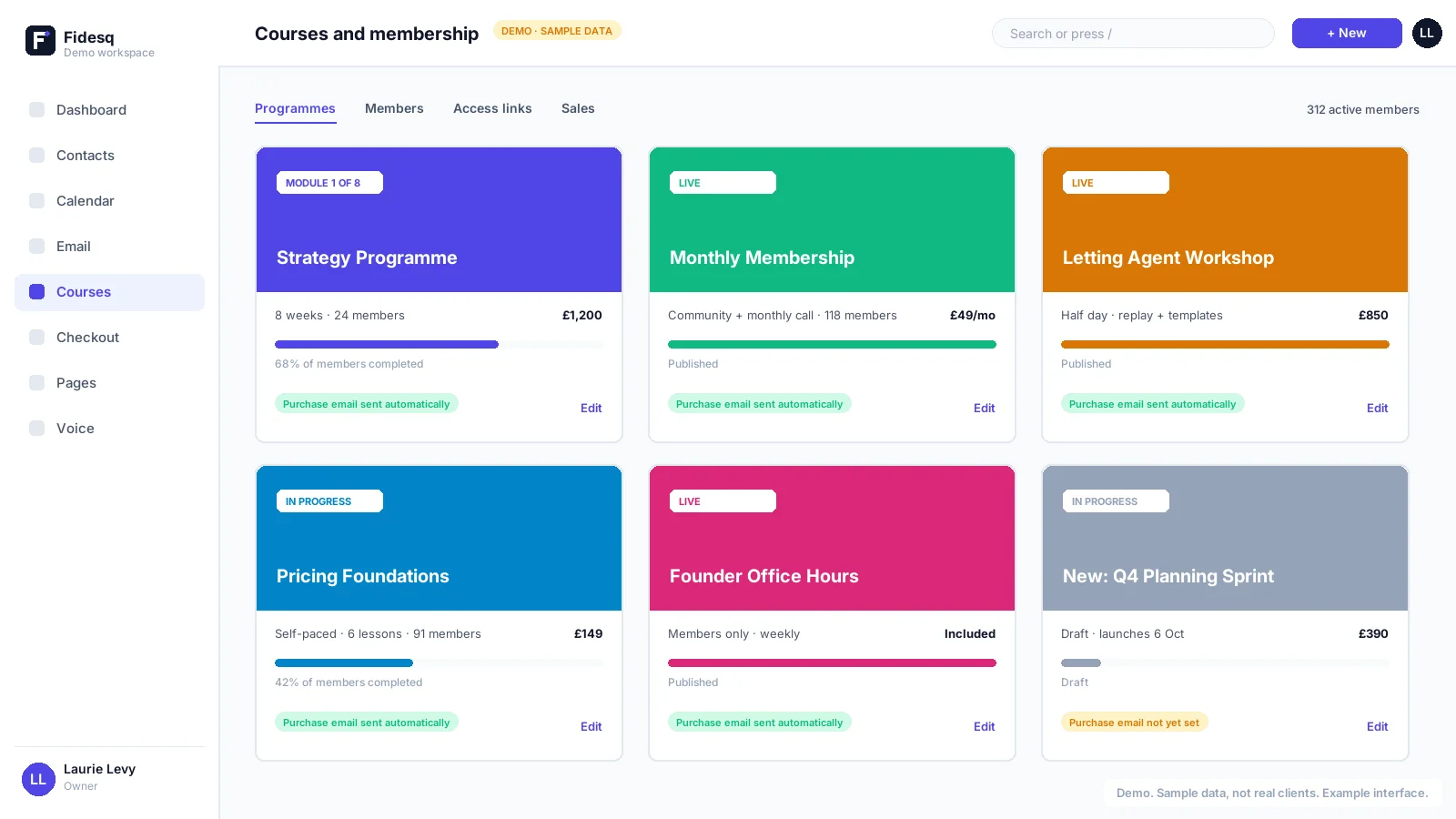
- A course and membership area, for businesses that sell what they know, in place of Skool Pro at £74 or Kajabi Basic at £134 a month.
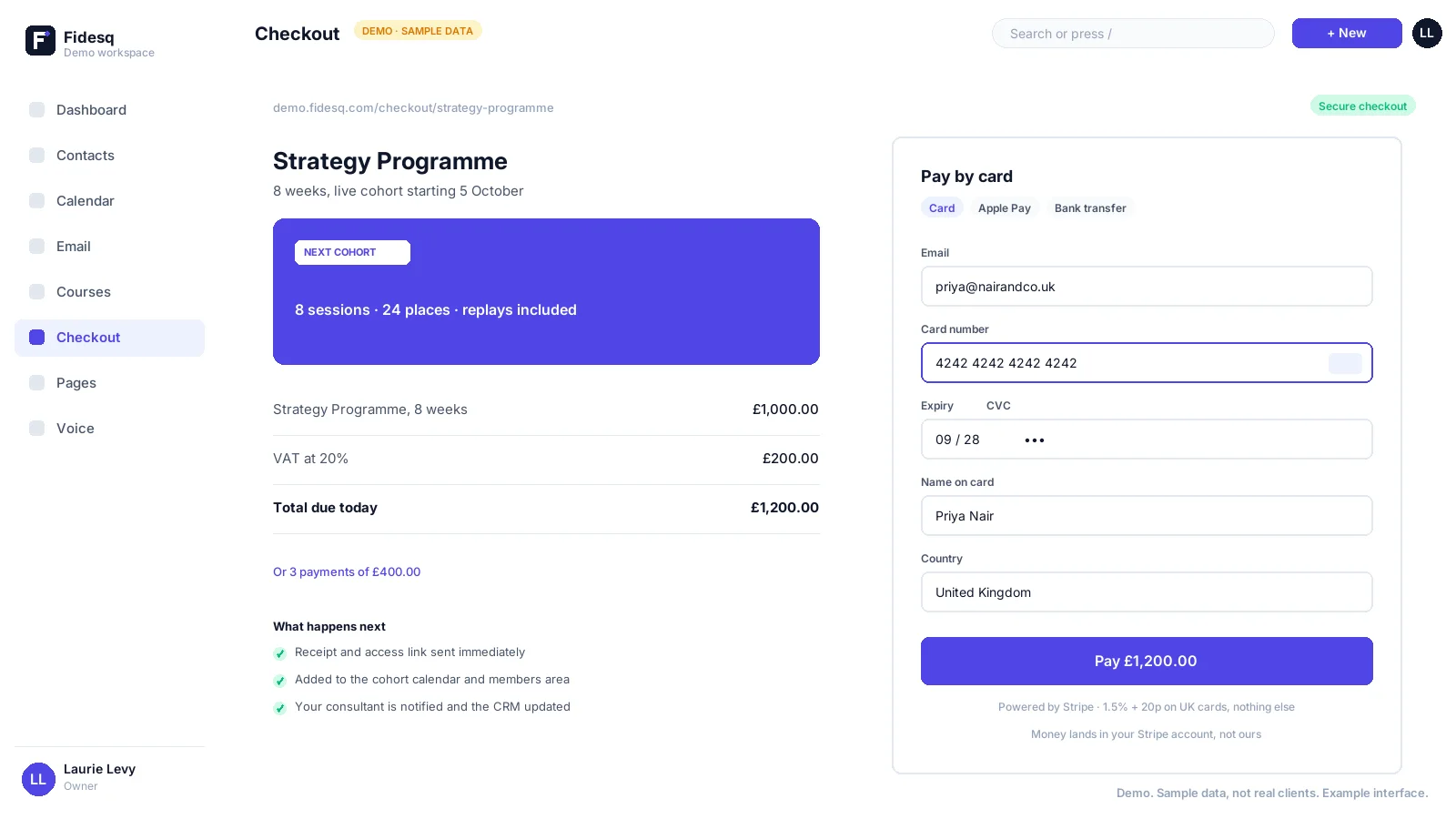
- Stripe checkout with a revenue dashboard, optional, where you take card payments online. Stripe's own fee of 1.5% plus 20p per UK card payment applies whichever tool you use.
- A voice assistant that adds contacts, books meetings and gives you summaries when spoken to.
I keep the system current and watched. Software updates, uptime monitoring, one change request a month for anything you would rather hand to me than ask the tools yourself, and a monthly report on what the system did. Teams that want to use it well from day one add AI workshops and training.
Ninety minutes with you and whoever answers the enquiries, a timed test of how the business handles one today, and a two-page plan that says what to build first and what to leave alone. The first step of AI Implementation.
What do you get to log into?
One login. The first three screens are the core CRM; the last three are the optional additions, shown so you can see what "also possible" looks like. Where the enquiries arriving in it start with someone asking an AI about you, the AI visibility audit tests what they are told first.
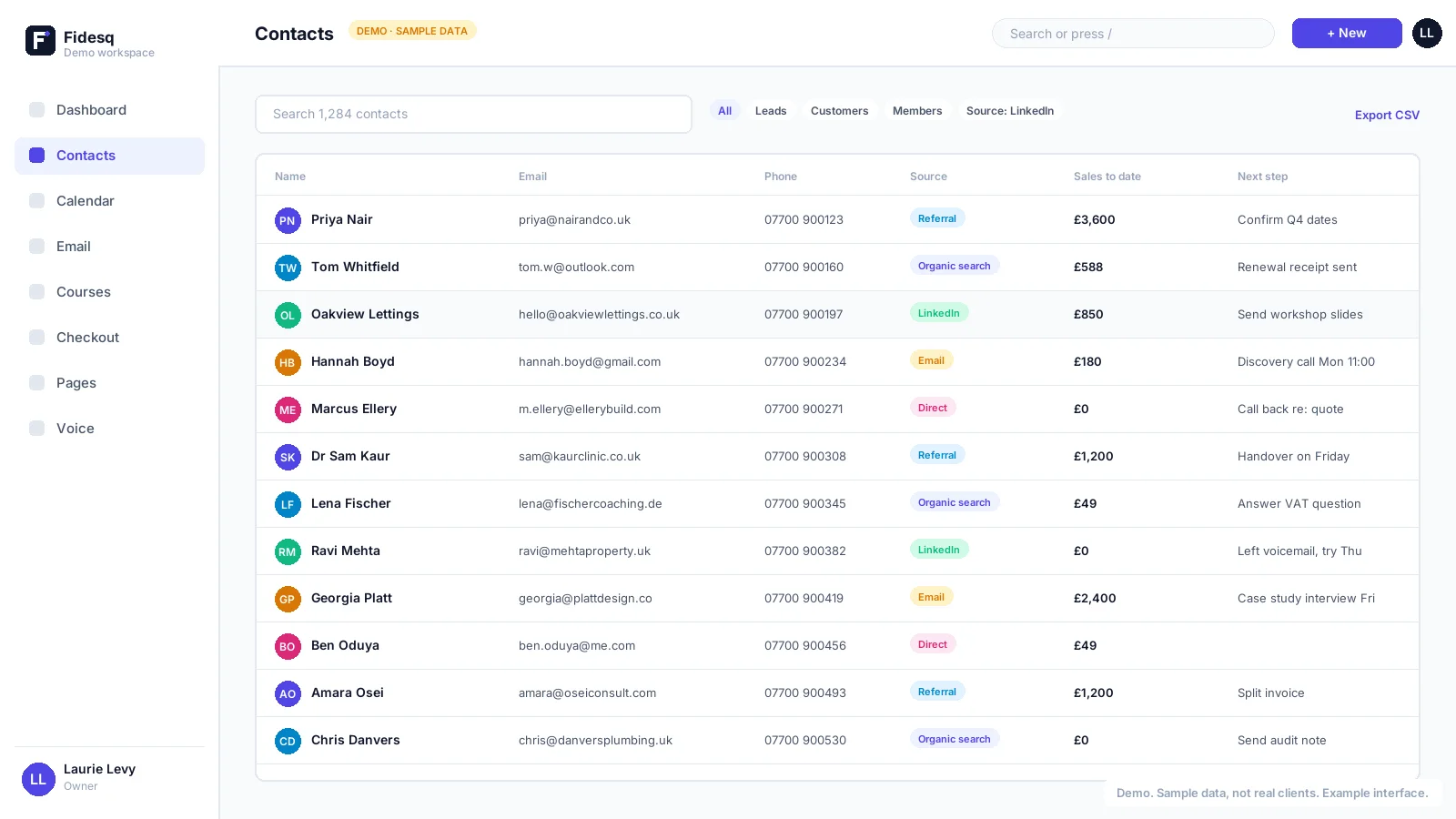
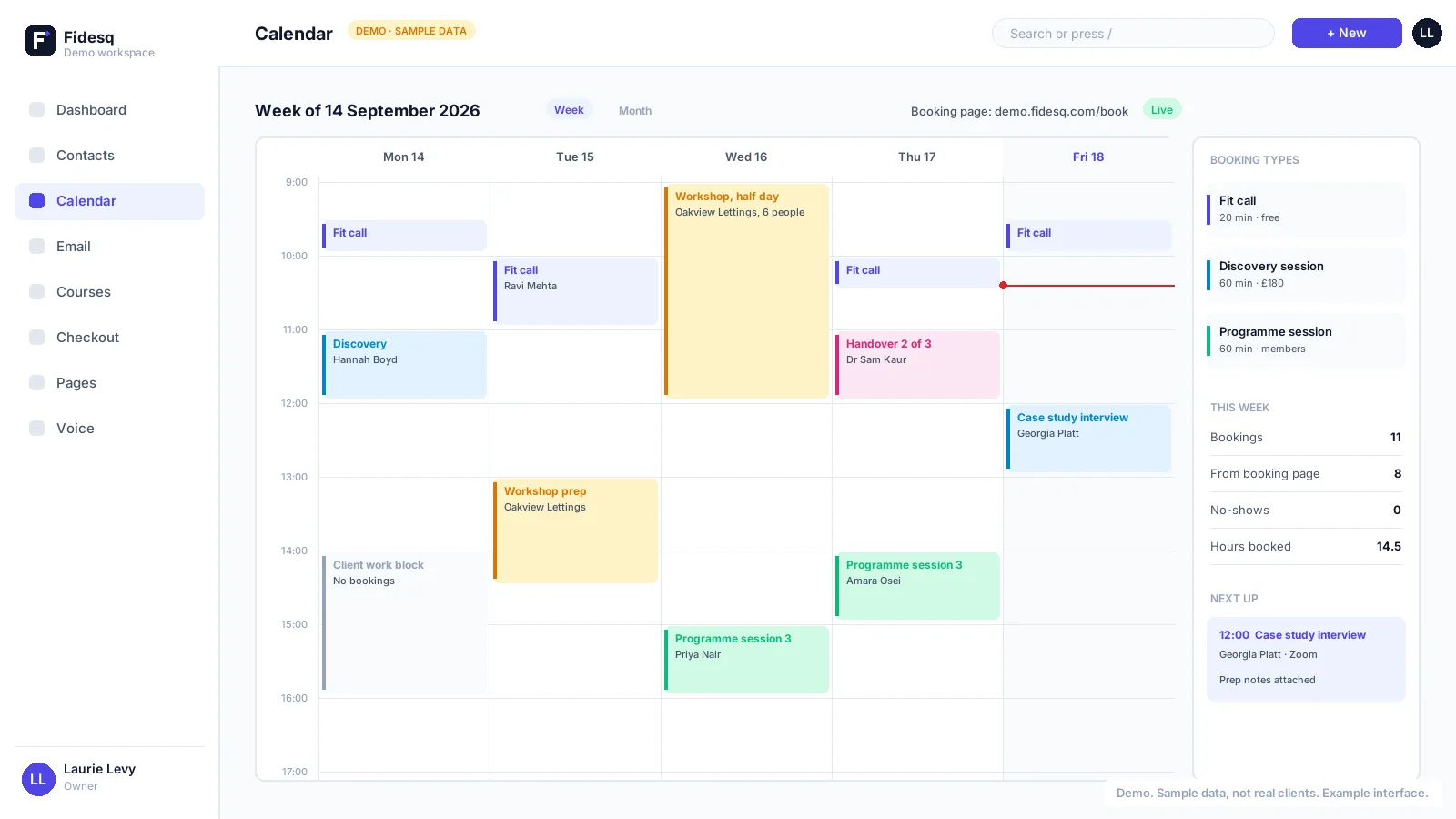
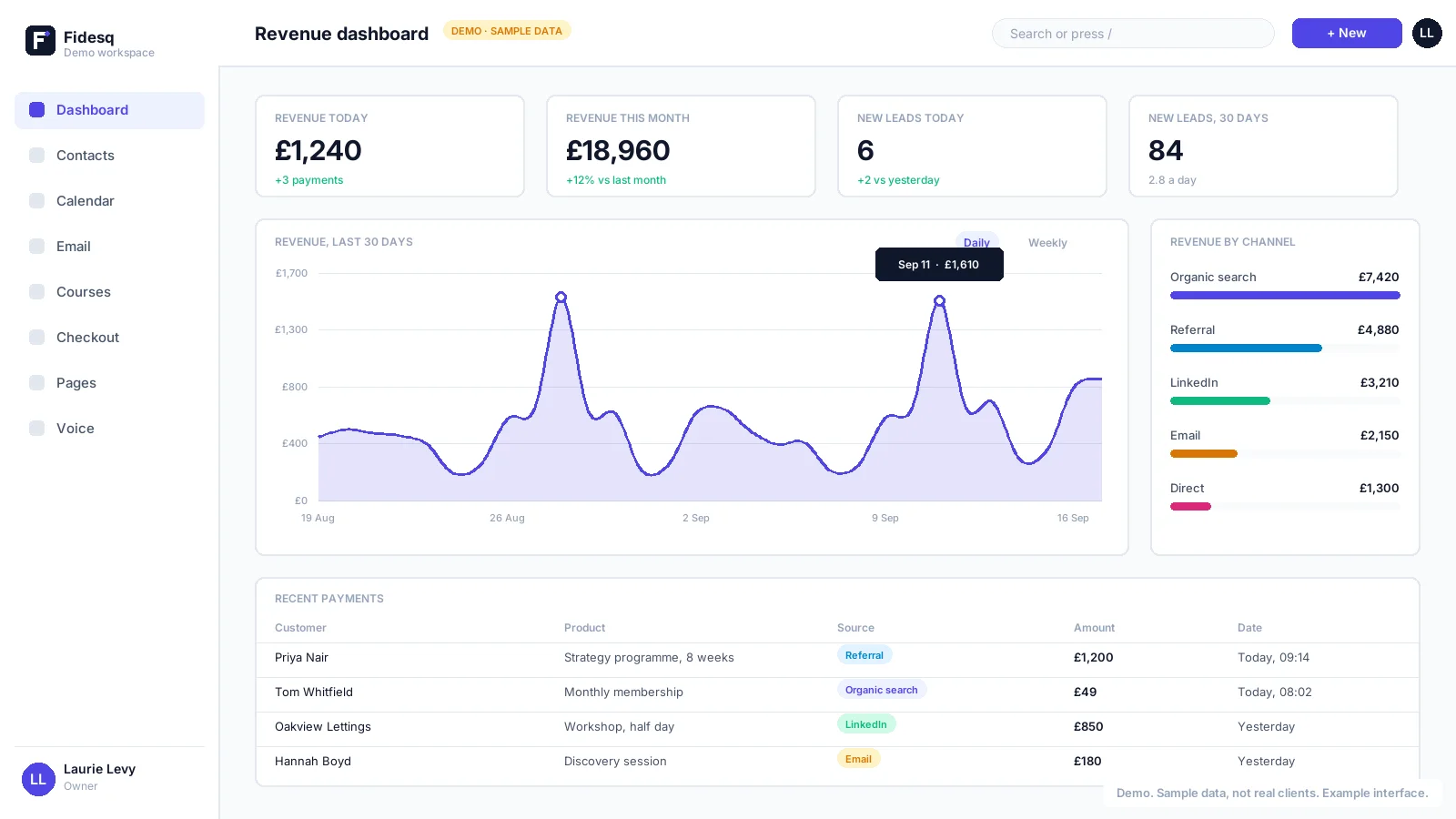
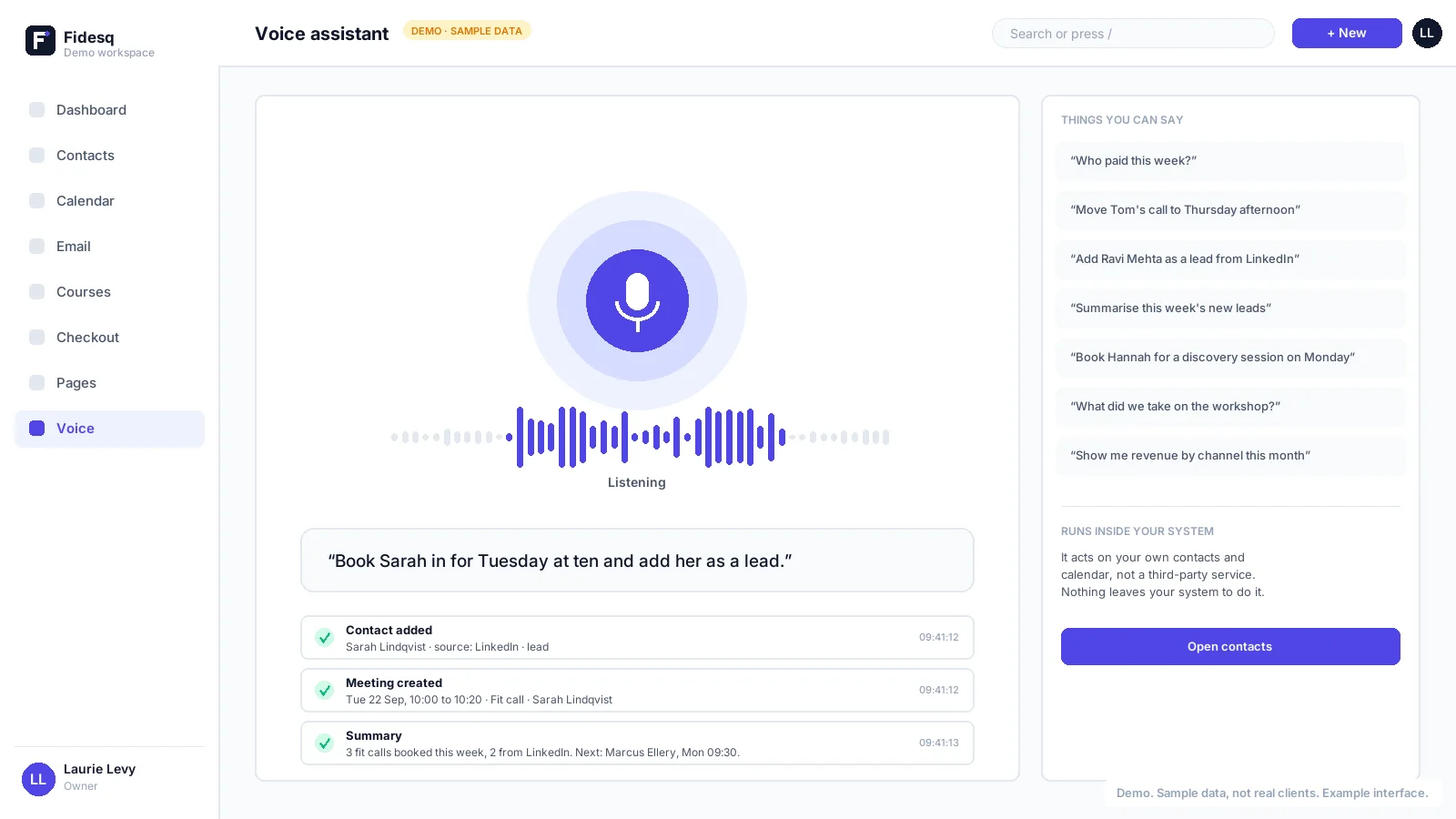
Contacts · 1 of 6
What you get, and what it asks of you
Four things a busy owner wants to know before a second call.
One owned CRM, one login. Every enquiry, follow-up sequences, bookings, invoice tracking and the weekly report, with Claude access to your own code, on a hosting account in your company's name.
You see it running on your domain with your own enquiries in it before the second half of the fee is due. Nothing rests on a slide deck.
Live in 10 working days from the go-ahead, backed by the guarantee above. Day 5 if your inputs arrive on time.
One call, about an hour gathering logins and assets, and three short training sessions. No Mac, no technical skill, nothing to install.
What changes beyond the monthly bill
The calculator shows the saving. These are the things it cannot show.
- One record per customer. Bookings, purchases, emails and notes on one screen, instead of stitched together across four tools.
- Tracking from page to payment. You see which source produced the revenue, without guessing across tools that each claim the credit.
- Nothing to keep glued together. No connectors to re-authorise, no failed automations to debug when a vendor changes something.
- No per-seat pricing. Add staff without adding licences.
- No vendor price rises or paywalled features. You own the code, so nothing moves behind a higher tier.
- Changes by asking. You keep Claude access to your own code, so additions are a request, not a developer quote.
- Follow-up nobody forgets. The sequence sends on the day it should and stops when the reply arrives.
- One place your customer data lives. Simpler to describe in your privacy notice, simpler to export, and yours if Fidesq disappears.
What will your stack cost over the next 24 months?
Tick the tools you pay for. It compares 24 months of your stack with 24 months of this CRM, because the build is a one-off and the stack bill is not. Each figure is the vendor's entry paid plan at monthly billing, checked on 18 September 2026 and converted to pounds where the vendor bills in dollars.
Tick the tools you pay for to see the numbers.
Book a 20-minute callSources, all checked 18 September 2026. Where a vendor shows only annual-billing prices, that is stated. Squarespace (Core £24 a month, monthly billing, UK page; Basic £16); Webflow (Premium $25 a month billed yearly; Basic $15); ClickFunnels (Launch $97 a month); Typeform (Basic $39 a month); HubSpot ($20 per seat per month, monthly billing); Pipedrive (Lite £14 per seat per month billed annually, VAT exclusive); Kit (Creator $33 a month at 1,000 subscribers); Mailchimp (Standard from £15.04 a month at 500 contacts, UK page); Skool (Pro $99 a month, 2.9% fee; Hobby $9 with a 10% fee); Kajabi (Basic $179 a month); Circle (Professional $89 a month, 2% fee); Teachable (Starter $39 a month, 7.5% fee; Builder $89 with no fee); Thinkific (Basic £46 a month, monthly billing, UK page); Calendly (Standard $10 per seat per month); Acuity Scheduling (Starter $20 a month, monthly billing); SamCart (Core $79 a month); Zapier (Professional $29.99 a month, 750 tasks); Make (Core $9 a month, 10,000 credits); Lindy (Plus $29.99 per user per month, 3,000 credits); Vapi (Core package $29 a month; platform usage $0.05 a minute plus model and telephony costs on top, so real monthly cost depends on call volume). Dollar prices converted at $1 = £0.748 (open.er-api.com, 18 September 2026) and rounded to the nearest pound. Annual billing, extra seats, higher contact tiers and usage change these figures. Vendors change prices; check the linked pages before deciding anything. Nobody uses all of these at once; tick what you actually pay for.
CRM for agencies: recruitment, marketing, consultancies
A CRM for agencies has to hold two kinds of relationship at once: the clients who pay and the people the work is about, whether those are candidates, contacts at a client or the prospects in a pipeline. Off-the-shelf CRMs price that per seat and make the second relationship an add-on. Here the record is built around how the agency actually works, so a marketing agency sees retainers, renewals and the next review date against each client, and a consultancy sees proposals, decisions and the follow-up that has not happened yet.
For recruitment agencies the same build holds candidates and clients on one record, with the placement, the invoice and the rebate period against it, and a follow-up sequence for candidates who went quiet. A dedicated page on CRM for recruitment agencies is coming; until then, the 20-minute call covers it.
How does it compare?
Only cells we could source from a vendor's own pages are filled. Where a vendor does not state something on the pages we checked, the cell says so rather than guessing.
| This CRM | GoHighLevel Starter | HubSpot Starter | Typical patchwork stack | |
|---|---|---|---|---|
| Monthly cost | Hosting about £5, Claude from about £15 (up to about £75 if you build heavily). Care plan £249, optional. | $97 a month, about £731 | $20 per seat a month, about £151 | Depends on the tools. Use the calculator above. |
| Who owns the data | You. It sits in a database on a hosting account in your company's name. | Not stated on the pages checked2 | Not stated on the pages checked2 | Varies by tool2 |
| UK data hosting | You choose the region on your own hosting account. The default host offers EU (Amsterdam) and US regions; it has no UK region.3 | Infrastructure in the United States4 | Data centres in the EU, US, Canada and Australia. No UK data centre listed.5 | Varies by tool2 |
| Contract lock-in | None. One build fee. The care plan cancels any time. | Month to month, cancel any time1 | Monthly or annual billing offered1 | Varies by tool2 |
| Per-seat pricing | No | No, unlimited users1 | Yes, priced per seat1 | Some tools, including HubSpot and Calendly1 |
| AI agent access | Claude access to your own code, on your own subscription. Changes by asking. | Not stated on the pages checked2 | Starter includes 500 HubSpot Credits1 | Per tool2 |
| Voice control | Optional. Adds contacts, books meetings, gives summaries. | Not stated on the pages checked2 | Not stated on the pages checked2 | Not stated2 |
| Course hosting | Optional, with the purchase email sent automatically. | Not stated on the pages checked2 | Not stated on the pages checked2 | Separate tool: Skool from $9, Kajabi from $179 a month1 |
| When you stop paying | Nothing changes. Hosting is the only ongoing cost and it is your account. | Not stated on the pages checked2 | Not stated on the pages checked2 | Varies by tool2 |
1. Vendor pricing pages listed under the calculator, checked 18 September 2026. 2. Not stated on the vendor pricing page we checked on 18 September 2026. Ask the vendor; their terms may cover it. 3. Railway deployment regions: US West, US East, EU West (Amsterdam), Southeast Asia. Checked 18 September 2026. Other hosts can be used if you need a different region. 4. HighLevel security and compliance overview: "Our product infrastructure resides in the United States." Checked 18 September 2026. 5. HubSpot data centres. Checked 18 September 2026. Product names belong to their owners. This table describes published facts and is not a claim that any vendor's product is deficient.
A CRM consultant in London who builds it too
Most CRM consultants in London configure a platform you then rent. I build the CRM itself, on hosting in your name, and I am the person who trains your team on it and answers the phone when something changes in month three. Reviews and training run in person across London, the South East and the Midlands; the build is the same wherever you are, because you see it on your own domain by day five.
Who is it for, and who is it not for?
I would rather lose a booking than build for the wrong business.
A good fit
- UK owner-led service businesses with 2 to 50 staff: consultants, coaches, agencies, trades and clinics.
- You pay for three or more tools like the ones in the calculator and would rather not spend time moving data between them.
- You sell something with a price: a service, a programme, a membership, a booking.
- You want to own the thing your business runs on and are willing to hold the hosting and Stripe accounts in your own name.
- You can give me about an hour of inputs in the first four days and attend three short training sessions.
Not a fit
- Telephony and SMS at scale. Call centres, dialler-led sales teams and bulk text campaigns need a dedicated platform.
- Teams over about 50 seats. Above that, permissions, audit trails and support needs change, and so does the right answer.
- Anyone who wants a vendor to blame. You own this system. That is the point, and it cuts both ways.
- Regulated data with a specific residency requirement that the available hosting regions cannot meet. Ask on the 20-minute call and I will tell you plainly.
Questions owners ask about a small business CRM
Do I need a Mac?
No. The system is a web application. You and your team use it in a browser on any computer, tablet or phone. The build tooling runs on my side, not yours.
Where is my data?
In a database on a hosting account opened in your company's name. You hold the logins from handover. The default host offers EU (Amsterdam) and US regions and you choose the region on the 20-minute call. I do not keep a copy of your customer data after handover.
How does UK GDPR apply?
You remain the data controller, as you are today with any CRM or email tool. The hosting provider, Stripe and Anthropic act as processors under their own published terms. The build changes where your data sits, into an account you control, not who is responsible for it. This is a description of the setup, not legal advice; check it against your own privacy notice.
What are the running costs?
Hosting at about £5 a month (Railway Hobby plan, $5, checked 18 September 2026), a Claude subscription from about £15 a month for day-to-day use (Claude Pro, $20 billed monthly, checked 18 September 2026; budget up to about £75 a month if you want Claude building new things every week), Stripe's standard fee of 1.5% plus 20p on UK card payments, and your domain renewal. The care plan is optional at £249 a month.
I already use HubSpot. What happens to my contacts?
You export them from HubSpot as a CSV during the input days. I import them into the new CRM with the fields you actually use, including lead source, mapped at the build. You keep HubSpot running until you have checked the import, then cancel it when you are ready.
Can I add features later?
Yes. You keep Claude access to your own code, the same tool I build with, so additions are made by asking rather than by hiring a developer, and I show you how in training. The care plan includes one change request a month for work you would rather hand to me. Larger additions are quoted separately.
What does the optional voice assistant do?
Where it is in scope, you speak to it in the browser and it acts inside your system: it adds contacts, books meetings and gives you summaries of what is going on, against your own calendar and CRM rather than a third-party service.
What support is included?
Three short training sessions during handover, a written runbook, and a 30-day period after handover in which anything agreed at the 20-minute call that does not work is fixed free. After that, the optional care plan at £249 a month covers updates, uptime monitoring, one change request a month and a monthly report, and you can cancel it at any time.
Is this a template?
No. It is one build for one company, on hosting you own, with your domain, your brand, your data and, where you take payments, your Stripe account connected. There is no licence to renew, no course to complete and nothing to install on your own machine.
What exactly is the guarantee?
Your CRM goes live within 10 working days of my receiving your logins and assets. If it is late and the delay is mine, half the setup fee is refunded. Days lost to missing inputs on your side, third-party outages (hosting, Stripe, Anthropic) or unanswered messages pause the clock, and I tell you in writing the same day it happens. Anything agreed on the 20-minute call that does not work is fixed free within 30 days of handover.
Is this a GoHighLevel or HubSpot alternative?
Yes, for a small business that wants to own its CRM rather than rent one. GoHighLevel Starter is $97 a month with unlimited users and its infrastructure in the United States; HubSpot Starter is $20 per seat a month with EU data centres and a large app marketplace. Both are good products with monthly bills that never end. This is one build fee, hosting in your name at about £5 a month, no per-seat pricing, and no vendor to leave. If you need SMS at scale, a dialler or hundreds of integrations, they are the better answer.
Two founders, one shared vision
Laurie and Roland bring together search expertise, product strategy, development and hands-on UK property experience. Laurie runs every call, build and handover himself.
Book a 20-minute call
Twenty minutes. I confirm what you use today, what the CRM replaces, and whether you are a fit. If not, you leave with a straight answer.
Or email [email protected] and I reply within one working day.